Propped Doors, Broken Culture: What Entryways Say About Your Organization
Walk through any facility long enough and you’ll see it.
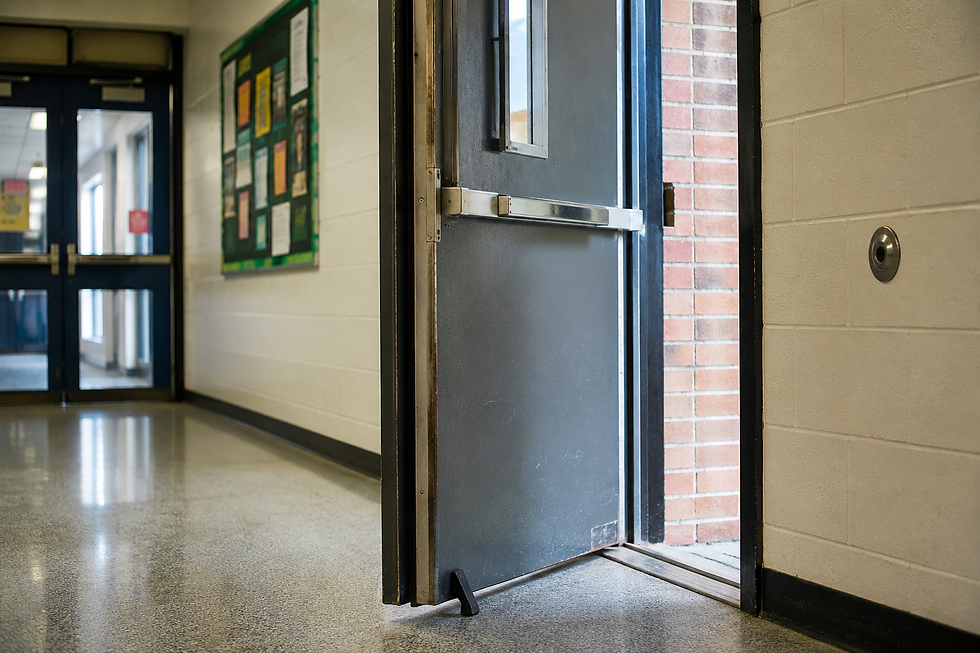
A fire-rated door tied open with a trash can. A side entrance that doesn’t latch unless you pull it twice. A stairwell door that “never really closes.”
None of these start as major failures. They start as habits.
And habits tell a story.
Doors Are Behavioral Signals
Doors are not just hardware. They’re behavioral infrastructure.
When a door is consistently propped open, it’s rarely because someone wants to violate policy. It’s because:
It’s inconvenient to reopen.
It sticks when it closes.
Staff are moving equipment.
“We’ve always done it this way.”
Over time, these small justifications create normalized risk.
A propped door becomes invisible. A broken latch becomes “that door.” And slowly, what was once a life-safety feature becomes decoration.
That’s not a hardware issue. That’s a culture issue.
Culture Is What You Tolerate Repeatedly
In organizations with strong safety cultures, small failures are corrected quickly. Not dramatically. Not punitively. Just consistently.
In weaker systems, minor violations accumulate until something forces change.
Entryways are one of the clearest, most visible indicators of which type of culture you have.
Do people report door issues immediately?
Are checks routine, or reactive?
Does leadership treat door failures as inconveniences or as risks?
If a door meant to secure, compartmentalize, or control access is left compromised daily, it sends a subtle message:
“This doesn’t matter.”
And when enough small things “don’t matter,” safety erodes quietly.
The Real Reason Doors Get Propped
Most propped doors aren’t acts of defiance. They’re friction responses.
When systems are unreliable, people create workarounds.
If a door slams too hard, staff prop it. If it doesn’t latch reliably, they assume it’s fine. If no one checks it, why should they?
Human behavior always optimizes for convenience. That’s not a flaw - it’s predictable psychology.
The solution isn’t harsher memos. It’s reducing friction and increasing accountability.
Accountability Changes Behavior
When entryway checks become routine - not annual, not occasional, but scheduled and visible - behavior shifts.
People act differently when:
They know someone is responsible for verification.
Reporting an issue is easy.
Repairs are tracked instead of forgotten.
Leadership treats door integrity as non-negotiable.
Consistency communicates priority.
Organizations that operationalize door accountability don’t rely on reminders or signage. They rely on systems.
That’s where DoorProof fits in - not as a maintenance tool, but as a culture reinforcement mechanism. By scheduling routine entryway checks, centralizing issue reporting, and making door performance visible, DoorProof removes ambiguity.
When responsibility is clear, culture stabilizes.
Small Signals, Big Consequences
Doors control:
Fire and smoke compartmentalization
Access control
Perimeter security
Emergency egress
Yet they are often the least monitored safety system in a building.
Sprinklers get inspected. Alarms get tested. Cameras get reviewed.
But doors - the physical barrier between safe and unsafe - are frequently assumed to be fine.
Until they aren’t.
The organizations that avoid crisis aren’t the ones with the most policies. They’re the ones with the most consistent execution.
Building a Culture That Closes the Door
If you want to evaluate your safety culture, start with three questions:
Are our doors functioning properly - today?
Would we know if they weren’t?
Who is accountable for verifying that?
If those answers are unclear, the issue isn’t hardware. It’s structure.
Strong cultures don’t rely on hope. They rely on process.
When entryways are treated as critical life safety assets - audited, documented, and routinely checked - they stop being afterthoughts and start being safeguards.
And when doors close consistently, culture tightens with them.
Make Entryway Accountability Routine
A propped door is rarely just a door. It’s a signal.
The question is: what is yours signaling?
If you're ready to move from reactive repairs to structured accountability, explore how DoorProof can help you make entryway integrity automatic - not optional.
Because culture is built on what you check.