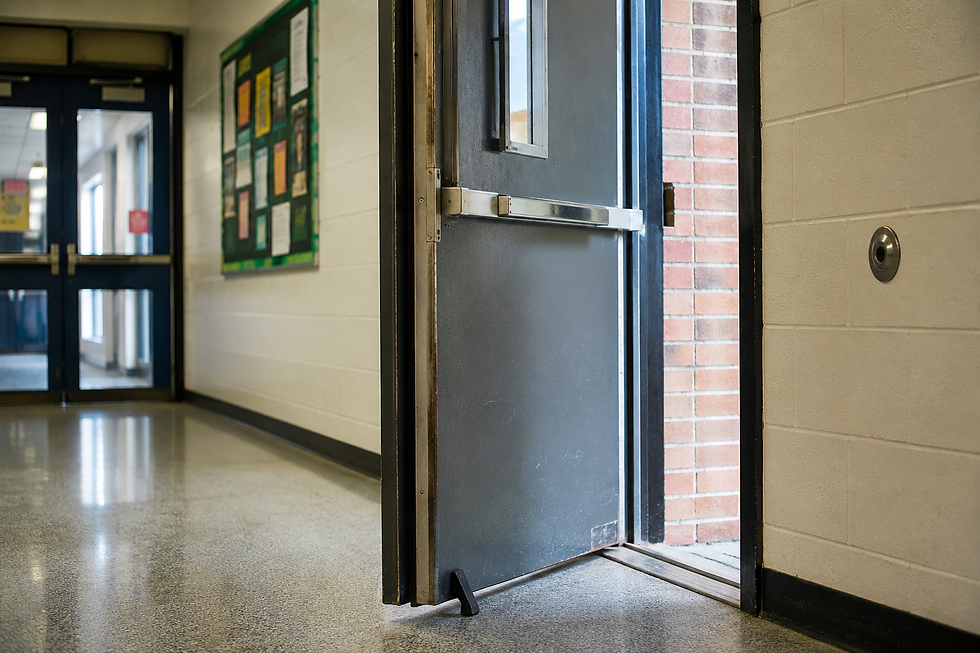
Doors, Frames, and Hardware as Life Safety Assets in Today’s School Safety Laws
How states like Missouri, Texas, Tennessee, Florida, Ohio, and others are codifying door security into school safety policy
Across the United States, state legislatures and regulatory bodies are beginning to recognize what many safety professionals have long known: doors, frames, and hardware are not just building components - they are life safety assets. In response to violent incidents in schools and the vulnerability of unsecured access points, lawmakers are increasingly embedding physical access control requirements into school safety laws. This includes mandatory locked exterior doors, routine inspections, documentation requirements, and even financial penalties for non-compliance in some states.
The trend represents a fundamental shift in how school safety is regulated: states are moving from optional best practices to enforceable safety standards focused on entryway security.
Texas: Weekly Exterior Door Inspections and Locked Access Requirements
In Texas, legislative and regulatory changes have created some of the most detailed door security requirements in the country.
Texas House Bill 5110, passed in 2025, amends the Education Code to require that school districts adopt policies ensuring that every exterior door to instructional facilities remains closed and locked at all times. Classroom doors must also lock appropriately and allow free and immediate egress without requiring unlocking action in emergencies.
Beyond the statute, the Texas Administrative Code requires school systems to conduct weekly inspections during school hours of all exterior doors of instructional facilities to verify that doors are closed, latched, and locked and cannot be opened from the outside without a key.
These weekly inspection requirements - often referred to as “door sweeps” - are now integral to statewide school safety compliance in Texas and represent a formal pivot toward treating doors as critical safety infrastructure.
Tennessee: Locked Doors, Inspections, and Funding Consequences
Tennessee requires all exterior school doors to be locked when students are present, with compliance enforced through inspections and financial penalties. K-12 schools must restrict access to a single secure primary entrance, and law enforcement officers may carry out unannounced inspections. Violations must be documented and communicated to administrators, district leaders, parent-teacher organizations, and state officials within 24 hours.
If a school violates the locked door requirements two or more times in a school year, it must implement a corrective action plan. Failure to comply may result in withholding of state funding - starting at 2% and increasing up to 10% for repeated violations. This funding-linked enforcement mechanism ensures that secure access control is mandatory, not optional.
Florida: Locked Instructional and Campus Access Points
Florida’s school safety framework emphasizes locked access points and secure door hardware. Under 2025 Florida Statutes Section 1006.07, all instructional space doors must be locked to prevent ingress when occupied by students, with limited exceptions when actively supervised. Campus access doors, gates, and other entry points must remain closed and locked at all times, unless actively staffed or approved through the Safe Schools Assessment Tool process.
Florida law also clarifies requirements for temporary or supplemental locking mechanisms that can be engaged or disengaged without compromising fire safety codes, balancing security with life-safety standards. Florida’s approach ties door hardware directly to broader safety and emergency response planning.
Ohio: Annual Door Assembly Inspections Under the Childhood Safety Act
In Ohio, the Ohio Childhood Safety Act (Bill 112) requires annual inspections of protective door assemblies in K-12 buildings. Qualified inspectors verify that doors with panic hardware, fire exit hardware, controlled egress systems, and other protective components meet safety standards.
This requirement goes beyond simple locked door policies to a formalized inspection regime for physical door assemblies, treating them as critical elements of overall school safety infrastructure.
Missouri: HB 1726 and Weekly Exterior Door Checks
Missouri’s House Bill 1726 (HB 1726) represents a major shift in school safety policy. If enacted, it would require districts to conduct weekly inspections of all exterior doors, confirming that doors are closed, latched, and locked and cannot be opened from the outside without a key. Schools must document inspections, report results, and address deficiencies through corrective action plans.
HB 1726 also requires districts to maintain detailed exterior door numbering plans, provide site layout documentation to emergency responders, and implement routine maintenance schedules for security components. The law is set to take effect for the 2027–28 school year, with compliance affecting accreditation status and eligibility for the School Safety and Security Matching Grant Program, which funds door hardware upgrades, security films, and inspection systems.
Missouri’s emphasis on weekly exterior door checks aligns it with states like Texas and Ohio, treating doors as essential life safety infrastructure rather than optional facilities features.
Other States Advancing Access Control Legislation
Illinois: Senate Bill 2692 proposes that school districts shall install door security locking means on both entrance and classroom doors that prevent unwanted entry and comply with accessibility requirements.
Indiana: House Bill 1388 (2025) would adopt NFPA standards, including NFPA 101 and NFPA 80, and require annual inspections of protective door assemblies by qualified inspectors, with reporting and remediation processes.
Arkansas: While not yet codified, reports recommend that all exterior and classroom doors be closed and locked during school hours, equipped with electronic access controls, and incorporated into facilities inspection protocols.
Federal Legislative Efforts and National Standards
At the federal level, the SAFER Schools Act of 2024 (H.R.10024) would direct the Department of Homeland Security to require improved installation or modification of interior and exterior doors to reinforce safety.
Standards like the NFPA 101 Life Safety Code and NFPA 80 also inform state legislative guidance around fire egress, locking mechanisms, and protective door assemblies.
Why Legislative Focus on Doors, Frames, and Hardware Matters
Doors and hardware are the frontline of physical access control. Policymakers recognize that:
Locked and inspected exterior doors are a foundational safety requirement
Routine verification and documentation are critical for accountability
Hardware performance, not just policy language, is essential to protect students and staff
Properly functioning doors and frames provide immediate, measurable security value at a relatively low cost compared to other safety investments.
Operational Reality: The Challenge of Compliance
Schools must manage:
Large numbers of exterior and interior doors
Aging hardware that may not meet new standards
Limited staff for inspections and documentation
Requirements to provide audit-ready records demonstrating compliance
Written inspection logs, accountability structures, and audit documentation reflect a shift toward treating door infrastructure as a regulated, reportable safety asset.
Looking Ahead
Many states are enhancing or proposing laws that:
Mandate locked exterior and classroom doors
Require routine inspections by qualified inspectors
Tie compliance to funding or corrective action plans
Align school practices with national safety standards
In this evolving context, doors, frames, and hardware are increasingly recognized as life safety assets that must be actively managed - not just when they fail, but as part of a structured, legally enforceable safety strategy.